The Omni-Tool Trap: Why AI Innovation Demands Skepticism

Artificial intelligence has functionally raised the floor on what people can do when it comes to building new things. Because of this new baseline, the ability to innovate, prototype, and demonstrate capabilities has become infinitely easier. But this speed has introduced a massive new problem: mass execution without operational discipline.
Since we have raised the floor on technical capabilities, it has become imminently important that we start teaching everyone to think critically about product design. Previously, this was a function reserved primarily for those explicitly building products for consumers. Today, everyone is immediately enabled as a builder. And without the right framework, they are building bloat within your organization.
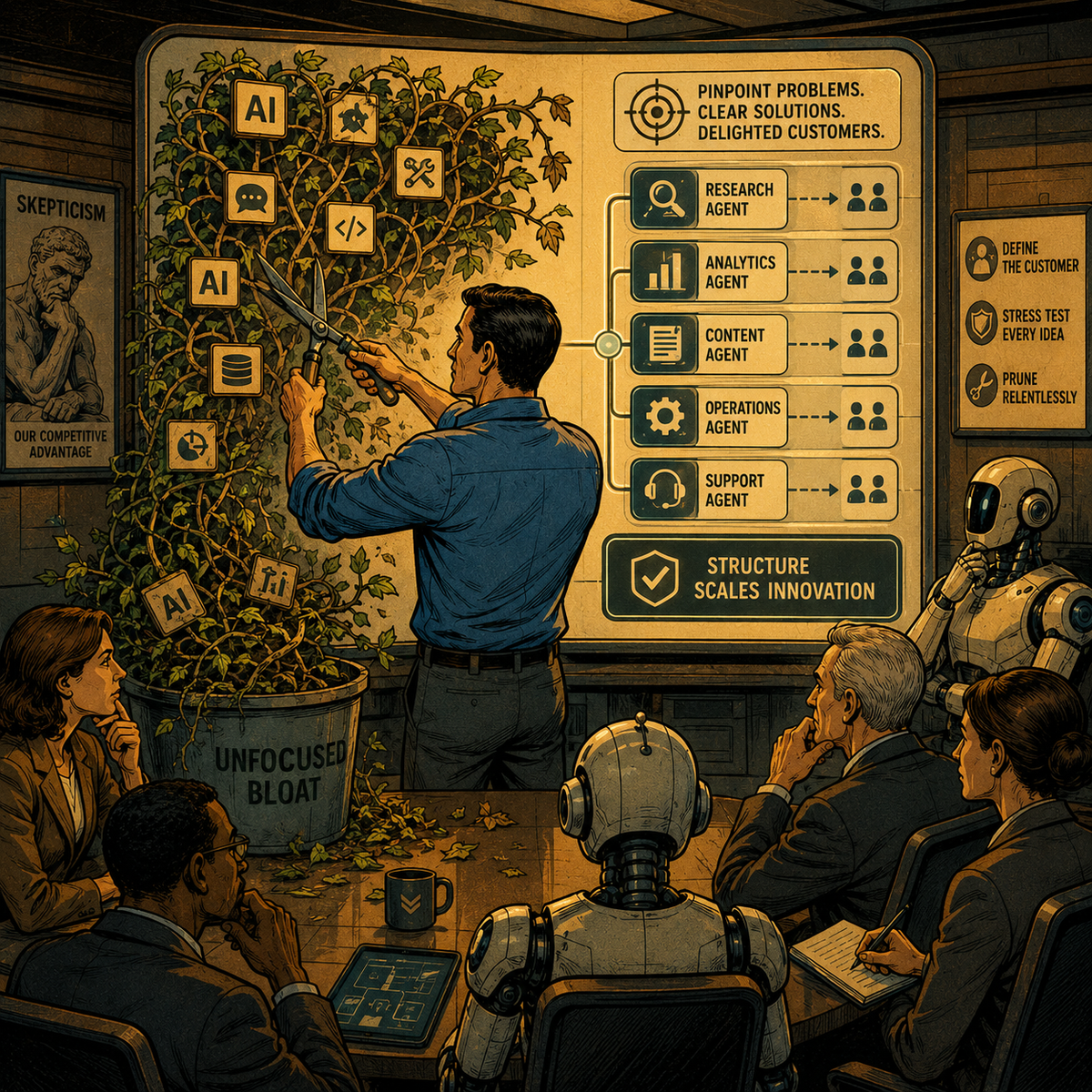
1. Pruning the Overgrown Innovation Garden
I speak with business leaders and owners about creating internal and external customer experiences for businesses daily. With the AI capabilities floor rising, it is apparent that the amount of pruning companies innovation gardens need has become excessive.
It is now commonplace to see five or six "innovations" aimed at the exact same problem. The result is multiple potential, viable solutions that are entirely underthought from the perspective of scale, support, problem statement focus and audience identification.
As I noted in Your AI Metrics Are Lying to You, if you do not understand how your organization actually works or common problems it addresses, no amount of dashboards or models will make you smarter. You will just automate confusion faster. It is incredibly easy to spin up a new prototype that looks like it will solve something. It is functionally entirely different to build an iron clad, scaled plan that both places the target customer at the center of the universe and delights them.
2. The Omni-Tool Trap
The most common mistake new builders make is going too broad. Everyone wants to build an omni-tool, rather than building a pinpoint solution that is highly helpful for a specific issue. Language models have made it deceptively easy to create general user interfaces where various functions and skills can be accessed.
But as explored in From Monolith to Modular: The Rise of Small Language Models, if you use a single monolithic model for every step of every workflow, you are effectively running a full-system query for a single-cell lookup. Rather than trying to optimize around one omni-tool that serves most roles adequately, we must build a segmented ecosystem of specialized agents, personas, and workflow automations. This is why agentic workflows are all the rage. That elegant orchestration of smaller, thoughtful steps is how you win the efficiency game.
By leveraging curated data and tightly bounded workflows, specialized tools reduce computational overhead, avoid compliance pitfalls, and drive measurably higher revenue growth. We need to design solutions that make it explicitly apparent when they should be used, what specific problem they solve, and exactly who the target audience is.
3. The Antidote: Institutionalized Skepticism
To fix this, we have to lean back on the fundamental functions of good product management. During my career at both Google and at Amazon, I learned to deeply appreciate the "working backwards" process. I have been a fan for a long time. I even help carry that culture torch in and out of the company as it aligns well with first principles thinking. The methodology forces builders to stress-test their concepts and become fiercely skeptical of their own ideas.
The research behind disciplined innovation backs this up. Case studies on the Working Backwards approach demonstrate that defining the customer experience first—rather than building costly prototype solutions that risk failing at launch—drastically improves product-market fit and long-term viability.
This process requires true skepticism. It cannot be followed repetitively based purely on daily energy or focus. Often, under pressure from peers and executives, the instinct to be skeptical of an idea is immediately threatened and pushed aside when an unreasonable deadline looms.
We can no longer afford to operate this way. We must constantly second-guess our ideas and actively welcome stress-testing from others. Having a mentor who helps crush up the paper and sends you back to the drawing board multiple times is not meant to be a stressful process. The ultimate intent is to produce an elegant product that solves a pinpoint problem, rather than handing a consumer something and leaving them thinking, "what the hell am I supposed to do with this?".
The Organizational Backbone
Organizations must establish general themes or align on primitive problems that their teams are solving for. Once that backbone is in place, away team organizations can focus on pinpoint solutions that weave into it. We are moving toward what can best be described as a Hybrid Model Architecture — a system in which different build teams are deliberately assigned to different workflow boundaries that are coordinated by a strategy that is apparent, easy to access and offers clean data that allows builders to understand how to use it.
If your leadership is not thinking about this intentionally, you must start. You need to educate your teams on how this landscape works and clarify their role within it.
You must ask yourself:
- Are our teams strategically aware that this cultural build shift is coming? It may already be here for some.
- Do builders know what their actual field of play is for functional deployments?
- Do they have access to the correct data required to build the functions that serve their specific roles?
If you are in enablement or leadership, these are the questions that should be floating through your head today. If your leadership team is not actively talking about these structural alignments, you need to get this meeting on the agenda as soon as possible.