You Can't Learn to Drive From a Manual. So Why Is That Your AI Upskilling Plan?

A colleague of mine recently described their organization's AI training program to me. They covered data structures, the importance of clean data, indexing, the do's and don'ts of their chat platform. Solid foundational content. Well-intentioned. And still, when I pressed them on whether people were actually using AI differently, the answer was a slow, uncertain no.
This is the gap I keep running into. And I think the analogy that explains it best is sitting in every driveway in America.
Teaching someone to use AI is not like handing them a new software manual. It is more like transitioning from walking — or riding a bike — to driving a car. The destination is the same. The mode of transport is completely different. And the behaviors, instincts, and skills required to operate safely and confidently in the new mode cannot be absorbed from a pamphlet.
Most organizations are handing their teams the pamphlet and calling it training. McKinsey's Superagency in the Workplace report found that 92% of companies plan to increase AI investment over the next three years — yet only 1% describe their AI deployments as mature. The gap between deployment and results is not a technology problem. It is a training architecture problem.
There are three components of driver's education that map directly onto what is missing from most AI programs. The instruction manual. The instructor. And the rules of the road. Most organizations are delivering one of those three things reasonably well. The other two are being left on the curb.
The Instruction Manual Is Not Enough
The glove compartment manual tells you how the car works. What the warning lights mean. When to check the oil. That knowledge is not useless — it is genuinely important. But nobody learned to drive by reading it.
Most AI training programs live entirely in this lane. They explain how the model processes data, how to write a cleaner prompt, what the platform can and cannot do. This is the instruction manual. It answers the question: what is this thing?
What it does not answer is: how do I think differently now that I have it?
That distinction matters more than most training designers realize. AI is not a faster way to do the same things you were already doing on foot. It is a different mode of movement entirely. The instincts that made you a reliable walker — careful, deliberate, bounded by how far your legs can take you — are not the instincts that make you a good driver. Some of them actively get in the way.
The same is true here. People who learned to work without AI built habits around information scarcity: exhaustive research before drawing a conclusion, treating a well-structured deliverable as the endpoint, assuming that good output requires long lead times. AI disrupts all of those assumptions. And no platform tutorial teaches you how to rebuild your mental model from the ground up.
McKinsey found that the single biggest driver of measurable AI impact is the redesign of workflows — not tool deployment, not headcount, not budget. Yet only 21% of organizations have fundamentally redesigned even some of their workflows around AI. The manual tells people what the car can do. It does not teach them to think like a driver.
Time Behind the Wheel: The Instructor Sitting Shotgun
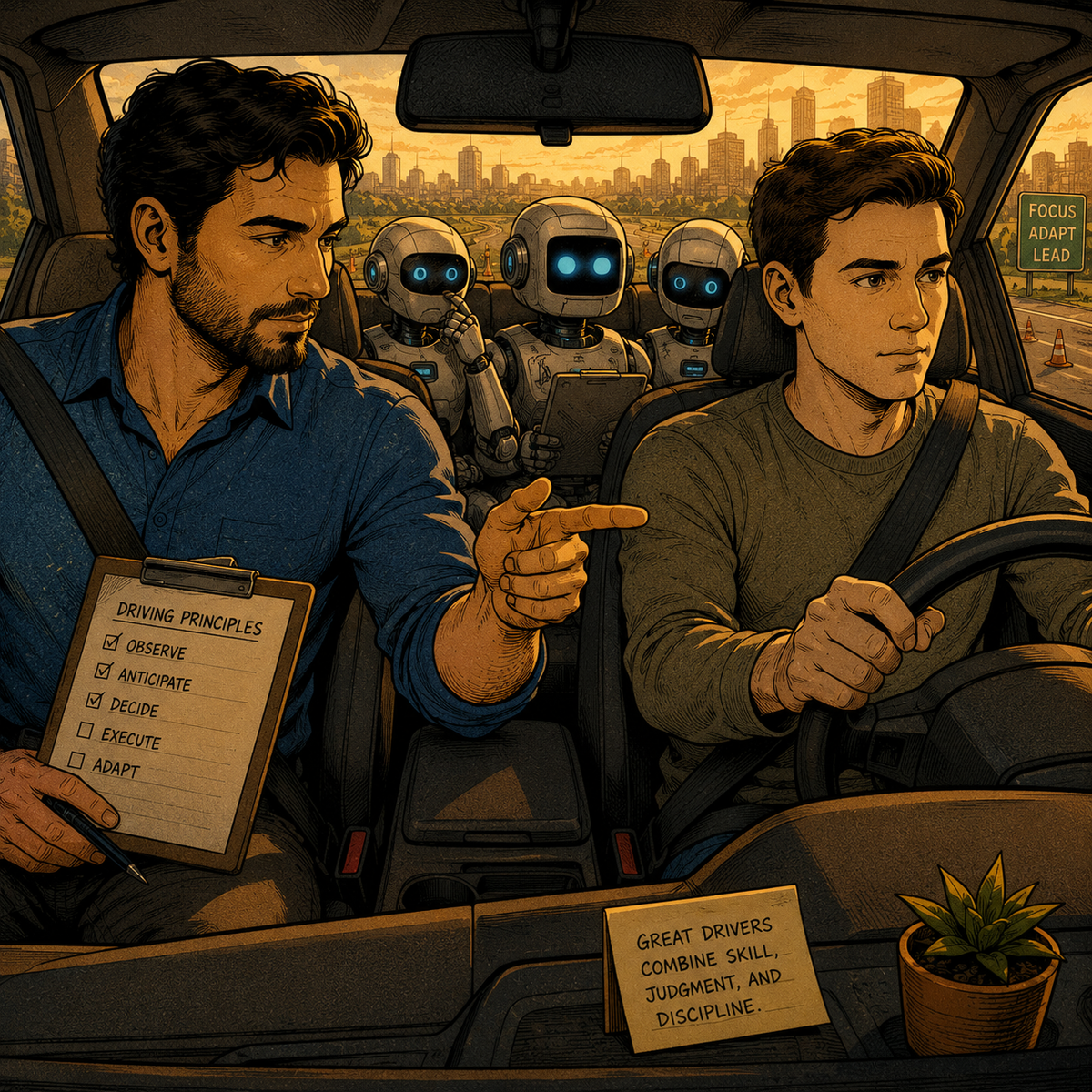
The most irreplaceable part of driver's education is not classroom instruction. It is the first time you get behind the wheel with an instructor in the passenger seat. They can feel how tightly you are gripping. They can see you hesitate at the merge. They can catch what no video ever could: the gap between knowing what to do and actually doing it under pressure.
This is what is missing from AI adoption programs at scale. Harvard Business Publishing's research on experiential learning is direct on this point: when learning a new skill, studying and listening only takes an individual so far — active involvement, real problems, and real-time feedback are what produce lasting behavior change. Video-based learning transfers knowledge. It does not build instincts.
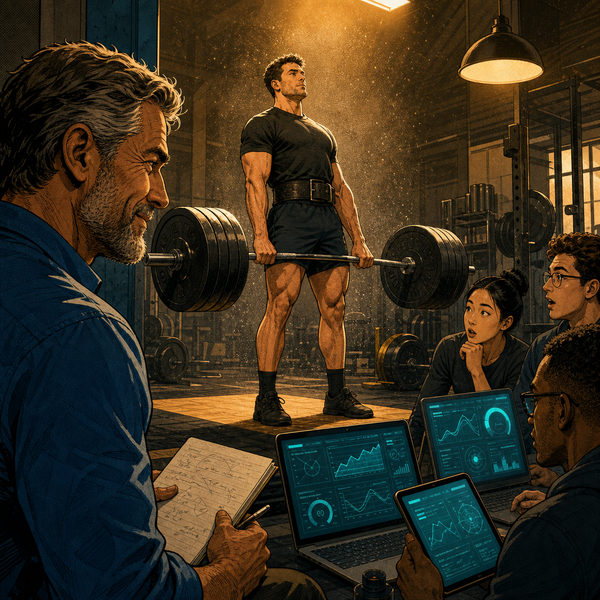
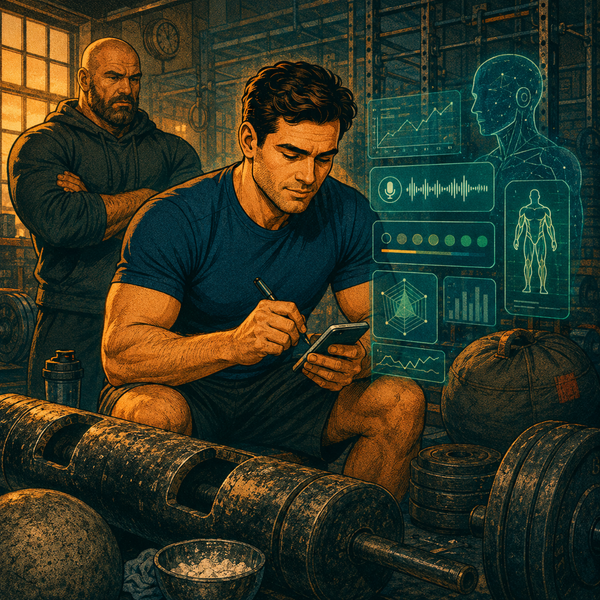
In practice, the AI equivalent of the driving instructor is the operator — an experienced practitioner who sits alongside someone doing real work and coaches them through friction in real time. Not in a classroom. Not in a certification module. In the actual workflow, on the actual problem, watching how they prompt, how they evaluate the output, and whether they are applying appropriate skepticism to what the model returns.
I wrote about this model in more depth in The Operator Model for an Agentic Future. The short version: most organizations will need a class of practitioners whose core function is not just doing work with AI, but developing the people around them who are learning to do the same. The operator is the instructor. The team is the student driver.
The friction points that an instructor can catch are specific and predictable. Most people newer to AI do not yet know how to ask a question at the right level of specificity, recognize when a response is confidently wrong and push back on it, work backwards from good research to build something genuinely novel, or separate the technical friction of setting up a tool from the cognitive friction of not knowing how to shape a problem. A training video can describe all of those things. A mentor watching you drive can fix them.
This is also why rewarding your highest performers with more projects — while the rest of the organization watches — does not scale. The bottleneck is human. And handing the fast drivers more road does not bring anyone else up to speed.
Rules of the Road: Why Organizational Vision Has Never Mattered More
Even the most skilled driver needs lanes. Not because they cannot drive — but because lanes make the whole system work. Without them, a thousand capable drivers become a thousand-car pileup.
The rules of the road in AI adoption are two things that most organizations underinvest in: a ratified compliance and security framework, and a clear operational field of play.
The compliance piece is non-negotiable. Your teams need a single, referenceable answer to the question: what is our organization's position on how AI is used internally? If that answer lives in a shared drive folder nobody has opened, or in a policy document that has not been updated since the first ChatGPT launch, that is a genuine risk — not a theoretical one. Go fix that now before you read the next paragraph.
The field of play is the harder problem, and the more interesting one. One of the quiet failure modes I see in organizations is the thousand-person-convergence: when there is no operational clarity about what teams are supposed to be building with AI, you get dozens of separate groups solving the same problem in parallel, with no centralized visibility and no shared output. Human time leaks at scale. Resources pool in the wrong places. And the people best positioned to drive real change spend their energy duplicating work instead of advancing it.
The answer is not to lock down innovation — it is to structure it. I have borrowed a principle here from Google's twenty percent model: roughly eighty percent of an individual contributor's AI activity should be directed toward their core business functions. The remaining twenty percent is protected space for experimentation and building new things. That ratio gives organizations the focused execution they need while creating room for the organic discovery that produces the next real capability.
But none of this works without organizational vision that is stated clearly and updated frequently. As I have argued in The Executive Playbook for AI Structural Change, roles and responsibilities inside organizations are shifting on roughly a two to three month cycle as new capabilities come online. Vision that was accurate in January may already be incomplete. Leaders who treat their AI strategy as a document they publish once a year are navigating a city with a map from three years ago. The roads have changed.
From Walking to Driving
The organizations closing the AI readiness gap fastest are not the ones with the most advanced tools or the most ambitious deployment timelines. They are the ones that understood early that this is a mode shift, not a skills transfer.
Walking and driving will both get you somewhere. But the cognitive load is different, the rules are different, the risks are different, and the instincts required are different. You do not bridge that gap by handing someone a glossy brochure about how internal combustion works. You bridge it by putting them in the car with someone who knows how to drive, making sure they understand the rules of the road, and giving them enough time behind the wheel that the new behavior becomes second nature.
Your AI program is only as good as the training architecture behind it. And right now, most organizations are running a driver's ed pamphlet program in a world that needs instructors.
If you are thinking about how to structure the instructor layer inside your organization, the Operator Model is a good place to start. And if you want to understand the broader arc of what it looks like when people move from resistance to fluency with AI, the Human AI Adoption Curve maps that journey in full.
The car is already in the driveway. The question is whether you are sending people out alone or putting someone in the passenger seat.