
The Human Architecture of Agentic Teams: Why Scale Demands Smaller Footprints

Artificial intelligence has functionally raised the floor on what a single person can execute. Because of this new baseline, the ability to build, prototype, and demonstrate technical capabilities has become infinitely easier and virtually free. But as I argued in The Omni-Tool Trap, this velocity introduces a massive new structural challenge: we are about to face a crisis of mass execution without operational discipline.
In an agentic world, execution capacity is no longer your bottleneck. The scarcest resources in your organization today are human judgment, critical thinking, and context-driven synthesis.
Yet, I speak with leaders every week whose immediate corporate instinct is to use AI efficiency to inflate a manager's span of control. They figure if tooling automates routine administrative coordination, a manager can seamlessly handle fifteen direct reports instead of seven.
This is a critical failure mode.
While agentic workflows increase output velocity, they drastically compress the time available for strategic calibration. If you inflate a manager's span of control right now, you systematically destroy their ability to offer the high-proximity coaching your team needs to steer those agents.
You will just automate confusion faster. If we want to survive the shift from workers acting as hands on deck to workers acting as captains, we have to radically re-architect the human infrastructure. MIT Technology Review recently confirmed this is not a future problem — AI agents are already accelerating business processes by 30 to 50 percent at scale, but notes this capability comes with greater complexity and the need for enterprise-wide organizational change.
1. The Core Inversion: Why Scale Demands Smaller Footprints
The post-Industrial model of organizational design — built on segmented excellence and massive, matrixed departments — is obsolete. When your execution layer can scale infinitely with compute, human team structures must invert.
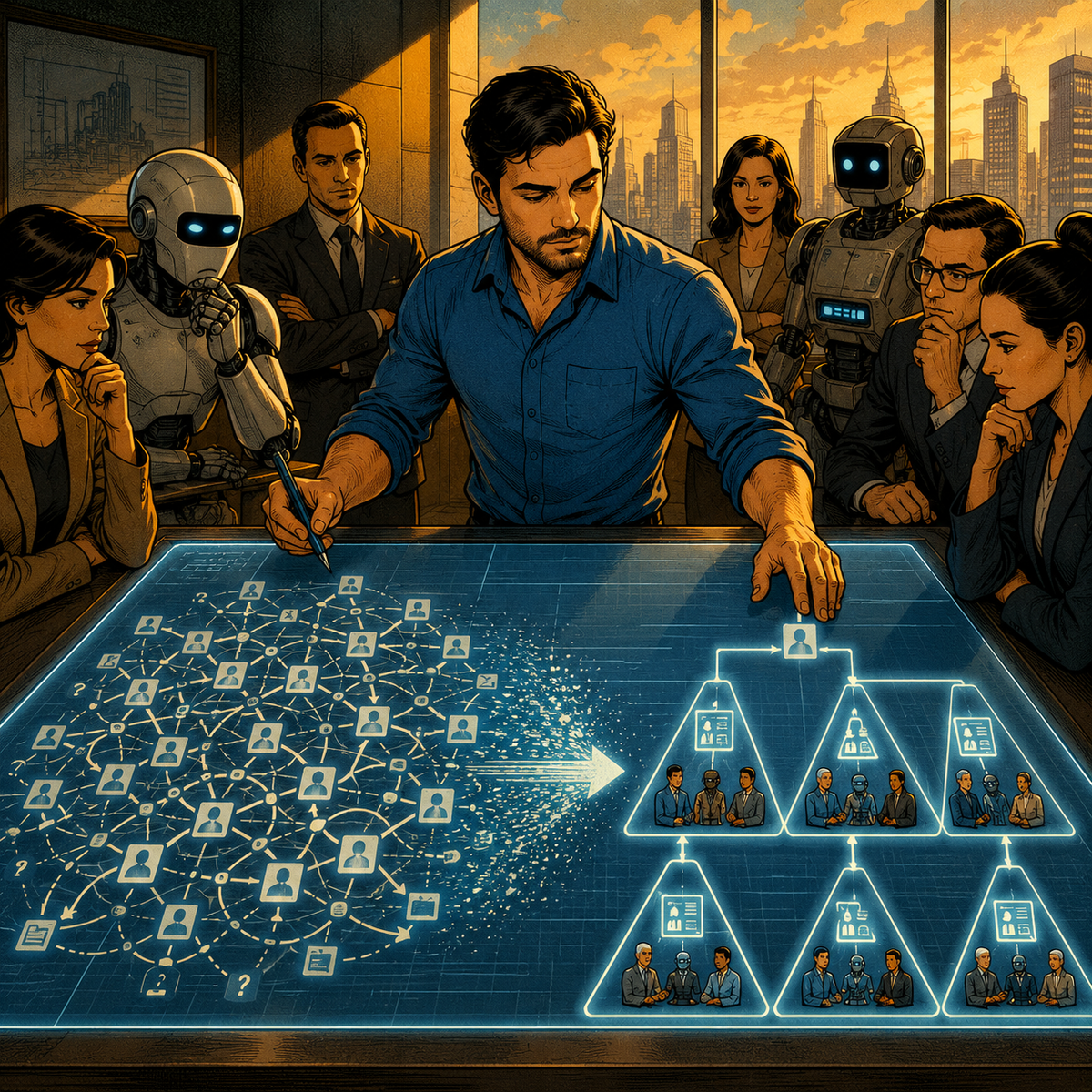
We need to move toward highly optimized, hyper-nimble micro-units of 2 to 4 people.
If you want the baseline philosophy on the operator vs. execution layer, read my breakdown on The Operator Model for an Agentic Future — but the tactical reality is that your physical org chart has to shrink. The research backs this up: McKinsey's Agentic Organization report found that a human team of two to five people can already supervise an agent factory of 50 to 100 specialized agents running an end-to-end process such as onboarding a customer, launching a product, or closing the books. These cells must be small enough to maintain perfect contextual alignment, move with hyper-velocity, and pivot their execution strategy without generating organizational drag.
To anchor these cells, we must separate day-to-day talent cultivation from macro directional steering:
The Manager-Coach: Directly embedded with a micro-unit, this leader's sole focus is high-proximity mentorship, continuous calibration of human judgment, and unblocking real-time technical friction.
The Strategy & Vision Manager: Sitting directly above the coaches, this executive oversees several manager-coach roles. Their mandate is pure sensemaking — synthesizing market shifts, protecting the broader corporate vision, and ensuring that high-speed micro-unit execution directly serves macro organizational goals.
If you don't reduce the surface area of your human teams, your managers will spend all their time managing tool sprawl instead of cultivating the faculties of their people.
2. Retraining the Human Router
For decades, corporate organizations have treated middle management as a human router — hollowed out into an administrative layer that moves status reports, tracks tasks, and balances resource allocation.
In an agentic environment, that entire task-tracking layer gets automated out on day one.
If we do not rapidly re-tool these managers to coach raw judgment instead of tracking throughput, we are heading straight for organizational cognitive atrophy. As I pointed out in AI Slop, when teams blindly offload synthesis to AI, their own critical faculties wither. The company becomes lightning-fast, but strategically blind.
McKinsey's April 2026 research on redesigning the technology workforce puts it plainly: hiring determines where human judgment sits in the organization, and capability building determines whether AI amplifies that judgment or bypasses it. Leaders must immediately prepare managers to operate across two new boundaries:
The Judgment Boundary: Managers must enforce where automated aggregation stops and human intuition begins. We've already covered how Your AI Metrics Are Lying to You when measuring pure output; the real demarcation line is between task types. AI is spectacular for Repeat Insight Work — like clustering themes across 3,000 raw customer feedback tickets. It is useless for Strategic Insight Work — like deciding which ambiguous market bet to make next quarter based on that data.
Escalation Engineering: When agents run continuous workflows, failures happen at the speed of compute, not business hours. Managers can no longer be passive reviewers. They must become system architects who design ironclad escalation protocols, teaching their teams exactly when an agent's drift requires human intervention.
3. Cultivating Bravery into the Infrastructure
You cannot build a high-velocity, agentic human architecture inside a low-trust, bureaucratic culture. If the penalty for an AI-accelerated experiment failing is career stagnation, your people will default to safe, low-value automation. They will stay in their swimlanes.
To unlock micro-units, you have to build Codified Bravery straight into your operational framework.
This means creating explicit permission structures and formal mechanisms — much like Amazon's Working Backwards process — that provide clear operational and career safety boundaries. It must say to the individual contributor: "You have explicit permission to step out of your narrow lane, take an intelligent risk, and apply your implicit knowledge to a novel problem using these models."
This matches the infrastructure principles I laid out in Using AI to Develop Teams That Actually Get Better. It creates an environment of radical curiosity, but establishes a clear sandbox. It ensures that when an experiment concludes or fails, it doesn't leave behind a hydra of unmanaged AI tools and fragmented organizational sprawl.
The Reality Check
The transition to an agentic future is explicitly an organizational design and leadership development challenge, not a technical deployment checklist. As I noted in Forecast or Fail, historical tracking mechanisms can't keep up with real-time execution. New information is being discovered weekly; new models are dropping daily. The old model of the annual or quarterly strategic pivot is dead. Healthy organizations must now be built to execute intentional, significant strategic pivots on a monthly basis.
The research is beginning to validate what operators on the ground already know. When I published The Operator Model for an Agentic Future in February, the idea of shrinking human teams around judgment-focused operators was still a contrarian take. McKinsey's Agentic Organization report landed on the same 2 to 5 person team structure shortly after. MIT Technology Review published a piece on rethinking organizational design for agentic AI three days after this post went live. When the academics and consultants start arriving at your conclusions, you know the window for early action is closing fast.
If you hand powerful, infinitely scalable agentic tools to an untrained, over-spanned corporate hierarchy, you will simply accelerate organizational chaos. True leverage is achieved by shrinking the human footprint of the execution team, radically sharpening their proximity to their leaders, and aggressively investing in the human judgment required to pilot the system.
Action Item:
Look at your current management structure. Are you trying to give your leaders more heads because of AI efficiencies, or are you tightening their focus?
Try breaking one over-encumbered team into a 3-person micro-unit for a single sprint. Strip their administrative reporting requirements, pair them with a dedicated coach under a clear strategic manager, and see how fast they can actually steer.