Part 2: The Coach and the Machine

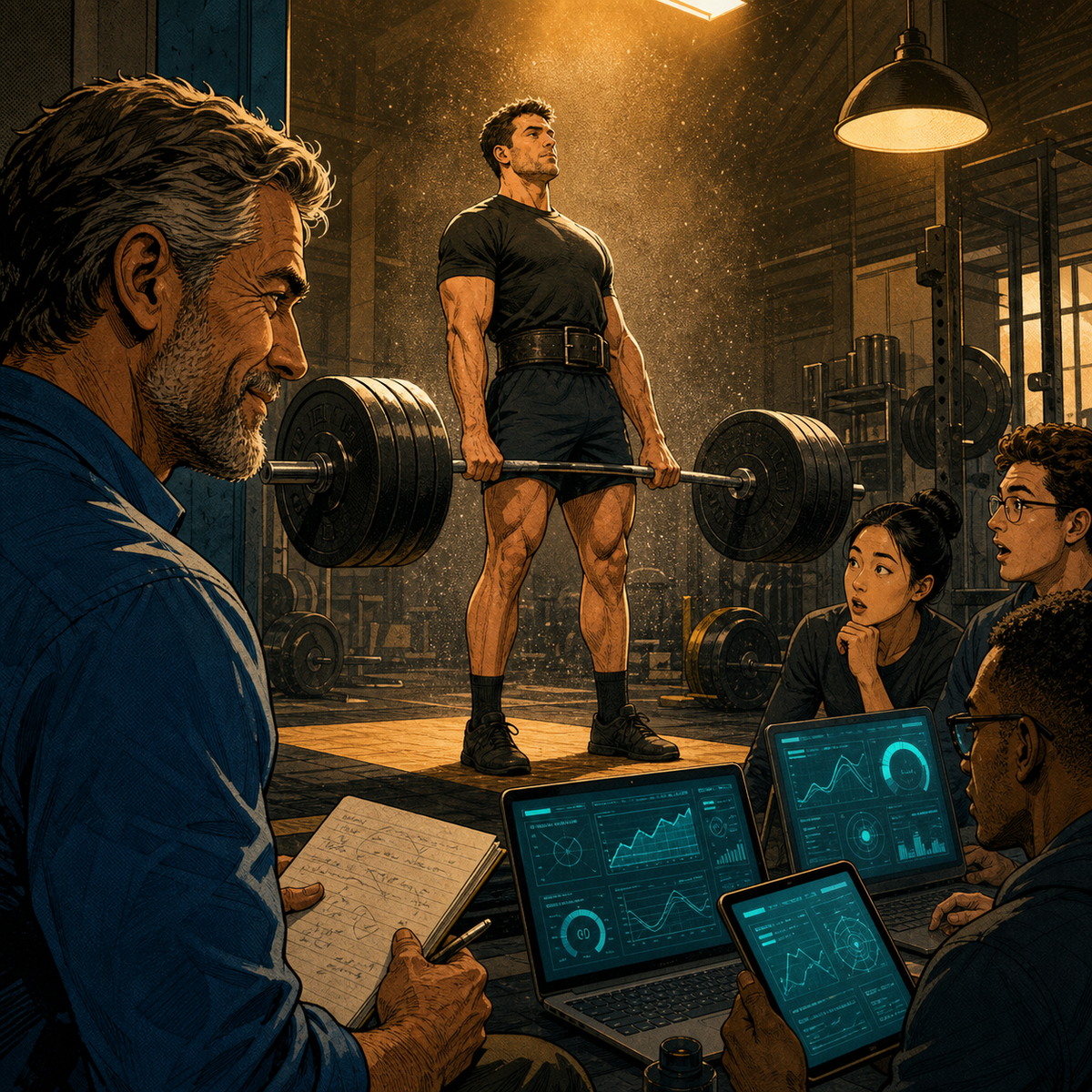
Picture a deadlift platform. Chalk hangs in the air. A big athlete is working up to a heavy single, music low, the room half watching.
In the corner, a team from an AI company is parked behind their laptops. They have fed months of this athlete's training into a model. Every rep, every bar speed, every recovery score, every readiness marker. The system has run the numbers and printed a verdict: here is the weight he is ready for today. Load it, pull it, do not exceed it. The data has spoken.
A few feet away, an older coach is holding a paper notebook. No screen. Pen marks, coffee stains, numbers scratched in by hand. He is barely looking at it. Mostly he is watching the man move. The way he is walking between sets. Whether he cracked a joke while he chalked up or went quiet. How the warmup bar left the floor on the last single, fast and mean instead of grinding. The set of his shoulders. The thing in the air that twenty years on a gym floor teaches you to read and no one has ever fully written down.
The coach glances at the number glowing on the laptop screen. Then he looks back at his notebook, then at the athlete. And he calls for thirty more pounds. Maybe forty. He says it almost like a dare, half a grin on his face, like he already knows something the laptops do not.
The room tightens. The plates go on. That is well past what the model said the body could give today.
The athlete steps up. Chalks his hands. Sets his feet. Grips the bar.
And he rips it off the floor like it owes him money. Lockout. Clean. Not even close to a maximal grind.
The laptops did not see that coming. The man with the paper notebook did. He was not working with more data than the machine. He was working with something the machine could not touch: the athlete, in the room, on that exact day.
In Part 1, I introduced ANIMA, the AI coaching system I have built over three years of competition prep. I made the case that the system is only as good as the human judgment sitting above it. This is the post where I explain what that judgment actually is, why it is becoming more valuable rather than less, and why the man with the paper notebook is not a relic. He is the future.
The Science Is Getting Cheap. The Art Is Not.
There are two halves to coaching. There always have been.
The science is the information and the technique. The physiology, the periodization models, the progression schemes, the established methods for getting a body from one level of capacity to a higher one. For most of history, this knowledge was the moat. You paid for access to a coach largely because they held information you could not easily get.
That moat is draining fast. AI has made competent method nearly free. Anyone can now get a reasonable training program, a sensible macro split, a defensible progression scheme in seconds. The science of coaching, the part you can write down and transfer, is being commoditized in front of us.
The art is a different thing entirely. The art is what the coach on the platform was doing. It is the ability to look at a living person on a specific day and know which part of the plan to trust and which part to throw out.
That skill is not getting cheaper. It is getting rarer and more valuable, because everything around it is being automated.
All Models Are Wrong. Some Are Useful.
The statistician George Box gave us the line decades ago: all models are wrong, but some are useful.
That sentence should be carved over the door of every gym and every office running on AI. A model is a compression of the past. It takes what has happened and projects it forward. By definition it is a simplification, and by definition it is incomplete. That does not make it worthless. A good model is enormously useful. It just is not the room.
The AI readiness system on that platform was not broken. It was working with everything it had. But everything it had was history. It had no access to the way the athlete walked in that morning, the conversation he had in the parking lot, the fact that he slept badly two nights ago but woke up today feeling like a freight train. The model held the average of the past. The coach held the reality of the present.
The coach's job, now and going forward, is exactly this: use what is useful in the model and discard what is not. That is not a rejection of the data. It is the highest possible use of it. The machine produces the signal. The human decides which signals to act on and which to ignore.
This is the role that survives. Not the person who can produce the plan, the machine does that now, but the person who can stand in front of the plan and the human at the same time and reconcile them.
The Logical Leap
Here is the thing a model structurally cannot do well.
A model extrapolates from precedent. That is its whole nature. It is exceptional at telling you what usually happens next given what has happened before. But coaching, like leadership, like any high-stakes human practice, is full of moments that have no clean precedent. The athlete is in a state the data has never quite seen. The situation does not map to anything in the history.
In those moments, a great coach does something the machine cannot. They take a logical leap. They reason from principle and experience into a situation that does not cleanly exist in the record, and they make a call. Sometimes that call is conservative. Sometimes, like on that platform, it is to add forty pounds because everything in twenty years of watching bodies move says today is the day.
That leap is not guesswork. It is judgment built from thousands of hours of pattern exposure that was never written down and never could be. It is the part of expertise that lives below language. The model cannot reach it because the model only knows what was logged. The coach knows what was felt.
I made this same argument about organizations in The Operator Model for an Agentic Future. The operator is the human with earned domain wisdom who stays accountable for the call when the data runs out. The coach on the platform is an operator. So is the leader who overrides a confident dashboard because they can feel something the dashboard cannot measure.
AI Does Not Make Us the Same. It Makes Us More Different.
Here is the part most people get backward.
The assumption is that AI personalization will converge everyone toward some optimized average. The opposite is true. As personalization scales, the number of distinct states a person can occupy explodes. We are entering an era of radical individual divergence, where the specific starting point of each person matters more than it ever has, not less.
When method was scarce, everyone ran roughly the same handful of programs. The variation between people was small because the available paths were few. Now that AI can generate an infinitely specific path for every individual, the relevant question is no longer which program. It is where exactly is this person right now, and what is the single best next increment from that precise spot.
That question can only be answered by observing the actual person. The starting point is not in the historical data. It is in the room, in the warmup, in the way the bar moved today. Which means the human who can read the live starting point becomes the most valuable layer in the entire system. Hyper-personalization does not retire the coach. It makes the coach indispensable, because the thing being personalized to, the real-time individual, is exactly the thing only a human can currently see.
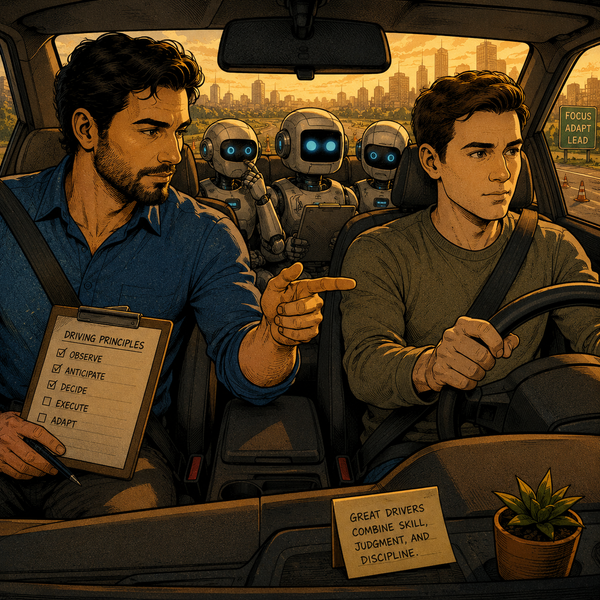
I touched the edge of this in the driver's ed post. You cannot learn to drive from a manual because the manual cannot see you hesitate at the merge. The instructor in the passenger seat is reading your live starting point and adjusting in real time. Same principle. The method is in the manual. The coaching is in the car.
The Coach and the Machine
ANIMA holds the ledger. It tracks everything, remembers everything, synthesizes across years of training in a way no human could. That is real and it is powerful and I would not give it up.
But the ledger is not the coach. The machine produces the model, and all models are wrong and some are useful. The thing that knows the difference, the thing that reads the room and takes the leap and decides which signal to trust on a specific Tuesday with a specific human under the bar, that is not in the machine. It runs through it. It is the ghost in the system, the human judgment that the whole apparatus exists to serve.
As the science of coaching gets cheaper, the art gets more valuable. As personalization explodes the number of individual states, the ability to read the live human in front of you becomes the rarest and most important skill in the building.
The laptops printed a number. The man with the paper notebook added forty pounds and was right.
That is the job that is not going anywhere. Not because the machine is weak, but because being useful with a wrong model has always been the most human skill there is.