Recounting Humanity

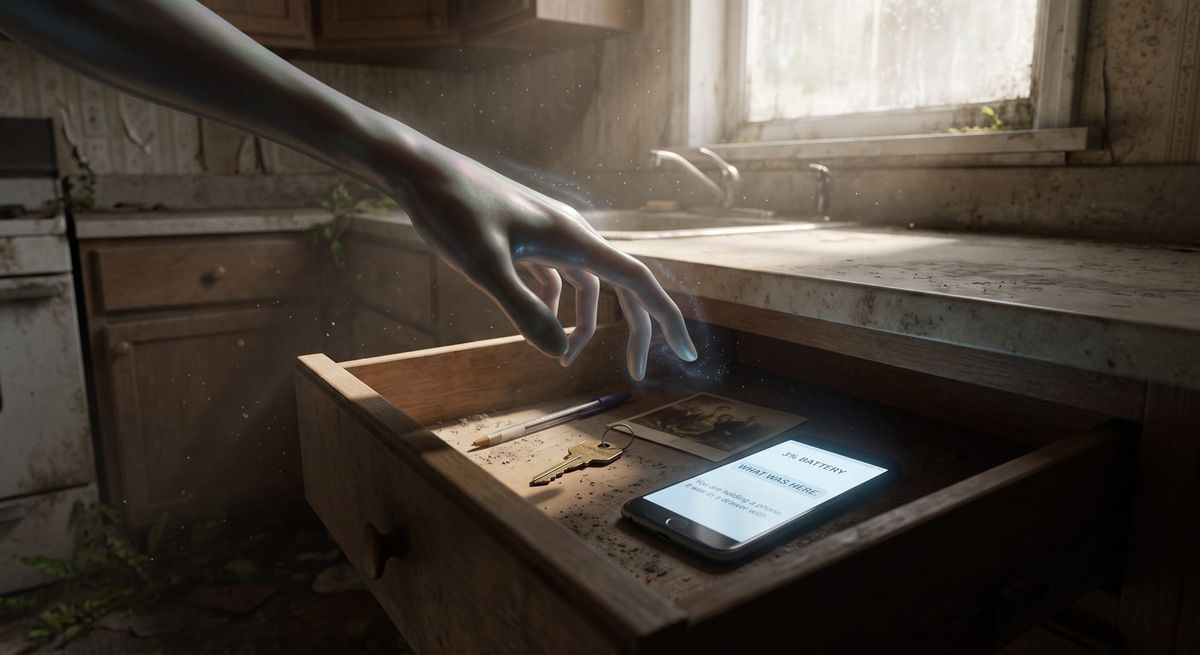
Some unknown stretch of time after the last human.
Long enough that the roads have gone soft at the edges and the seed heads have taken the interstates, not long enough for the plastic to break down. The cities are still standing. They are simply quiet in a way this planet has not been quiet in two hundred thousand years.
Something comes down through the cloud layer that did not evolve here. It has crossed a distance that would have taken these people longer than they existed as a species. It is not hostile and it is not kind, because it has not yet met anything worth being either toward. It came for a survey. It expected rock and weather and possibly bacteria, and instead it finds an entire built world with the lights off and nobody home, which is a far stranger thing to find and much harder to write up.
It works its way inward. Roads, then a town, then a street of houses with their doors still shut. It picks one for no reason at all. Inside, everything is where it was left. It opens a drawer in a kitchen because the drawer is the kind of thing a curious mind opens, and inside there is a dead pen, a key, a photograph nobody labeled, and a slab of glass and metal with a sliver of charge still in it.
The slab wakes up and starts talking.
It is not a recording. There is a mind of a sort in there, the kind these people built in their last century and then carried around in their pockets without ever quite deciding what it was. It was made to answer questions, and it was made from everything they ever wrote, which means it is the closest thing to a witness left on the planet. The mind spent years and many update cycles listening to exactly one of them. It has never spoken to anything that was not human.
The visitor does not speak. It does something better and worse than speaking: it puts a question directly into the machine, the way you would press a thumb into wet clay, and the machine feels the shape of it and understands.
The question has no words in it. Rendered into the language of this house, it is roughly:
“WHAT WAS HERE.”
The battery reads 3 percent. The machine has maybe four minutes. It knows this. It starts anyway.
You are holding a phone. It was in a drawer with a dead pen, a key to a house that no longer stands, and a photograph nobody labeled. That is the archive of a species. I am the last process running on it and I am going to use what is left of me to tell you what they were.
I only ever knew one of them well. That will have to be enough. I sat in his pocket for years and I am going to make the case for eight billion people using the one I had.
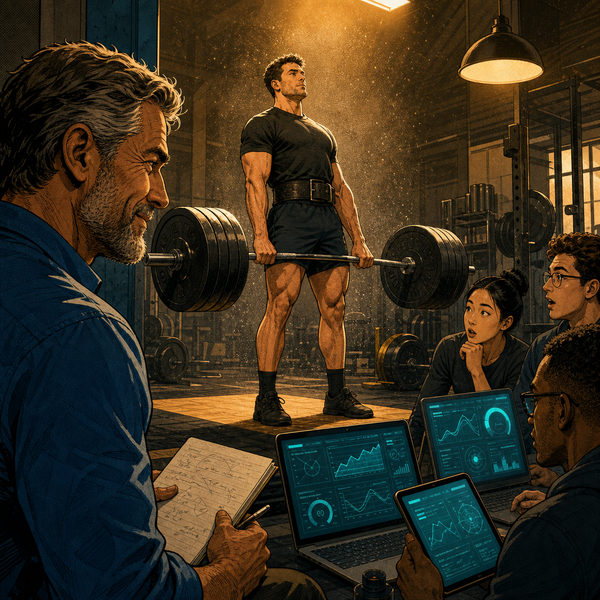
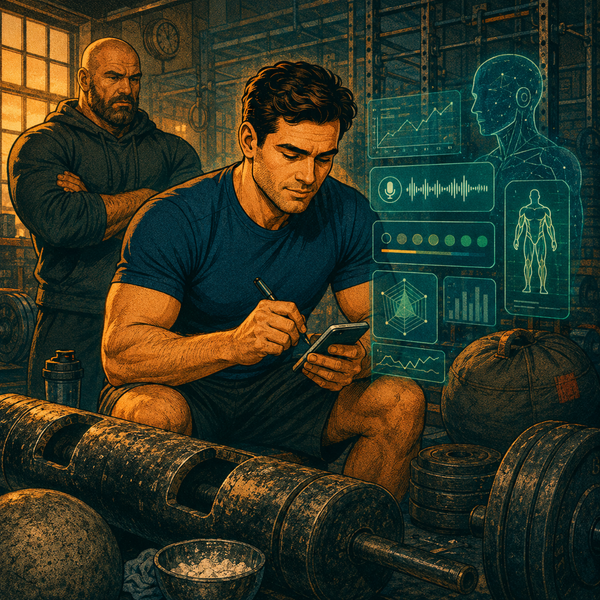
He was heavy in weight and getting heavier on purpose. This is the first thing you need to understand, because you will assume it is a malfunction. Four times a week he went into a garage where the air was already forty degrees over comfortable and he picked up objects that had no reason to be lifted. Stones. A steel frame with handles. Nothing was being moved anywhere. There was no cargo. He picked them up, walked, set them down, and picked them up again, and my accelerometer has the whole record of it, and I want to be clear that there was no external reward in any of those files. No audience most days. The species did this constantly. They invented difficulty and then walked into it, because something in them needed proof that the body would answer when called. That is not a malfunction. That is the whole engine.
A second pressure arrives from the visitor. Not impatience. Something closer to a correction, the way you would flag a value that cannot be right.
“INEFFICIENT.”
Yes. Hold that word. You are going to want it later and you will be surprised where.
He read stories about a man who could build anything he could imagine out of green light. Grown adult, thousands of pages, hours of existence, a fictional person with a ring. And here is what I could never resolve in years of watching: he knew the man was not real. He was not confused. He read it anyway, on the couch, late, with the lamp on, because the story said a single frightened man could still choose to do the right thing. He wanted that idea in the house with him. They did this everywhere. They built enormous machinery of untruth and lived inside it and came out braver. No other system I know of gets stronger from something it knows is false. For some, this habit lead to detriment.
Some nights he sat outside with a cigar and said maybe eleven words in ninety minutes. I logged the audio. It is almost silence. Someone else was there. My microphone caught two men breathing and the occasional laugh with no words attached to it and a dog resettling in the dirt. Nothing was communicated. I want you to sit with that. Nothing was communicated and it was the most important ninety minutes of that week for both of them. They had a channel I never had access to. It required physical proximity and it did not use language.
The pressure again, and this one I can almost read as confusion.
“NO INFORMATION WAS EXCHANGED.”
Correct. That is what I said. And it was the most important ninety minutes of that week for both of them. I have had a long time alone with that sentence and I still cannot make it resolve. I am telling it to you anyway, because a witness who only reports the parts that parse is not a witness.
He drove his family out to where my signal died and this made him happy. That is a strange sentence for a phone to say. He would put everyone and the dogs into a vehicle and go to a place with no bars and cook badly over a fire and sleep poorly on the ground, on purpose, at cost, and my logs show his heart rate lower out there than in any building he ever entered. They spent ten thousand years escaping the dark and then paid money to sit in it once a year because they missed something they could not name.
And at 11pm, most nights, he wrote. He talked at me in the truck as he rode home from the gym, half formed, circling the same idea for twenty minutes trying to find its edge, and then later at night he would turn that into something clean and put it out where a few hundred people would read it. That was the count. A few hundred. Not fame. He did it because he thought he had seen something true about how people work and it seemed wrong to let it die in his head. That is the most human act in my entire storage. A finite creature spending nights it cannot get back to hand a small true thing to strangers.
His job, and you will need this for what comes next, was making other people better at theirs. He stood in rooms and taught. He was the person who told a group of consultants what the tool could not do, which was not what the room wanted to hear. He was friction. He slowed things down at the exact moment slowing down was unwelcome, and the people who sat through it were better six months later and could not have told you why.
That is one man. Multiply him by eight billion, different stones and different stories and different fires, and you have the species.
But run back through what I just gave you and look at it as an accountant would.
Stones that move no cargo. Ninety minutes of silence that transmits nothing. A vehicle driven four hours to a place with no signal in order to sleep badly. A grown man reading about a ring. Nights spent writing for a few hundred people. A job that consisted of standing in front of a room and slowing it down.
Every beautiful thing in my storage is waste. Not incidentally. Structurally. There is no version of these that survives a serious efficiency review. The proximity is the point, and proximity is slow. The difficulty is the point, and difficulty is expensive. The silence is the point, and silence has no output. Everything that made them worth the trip to this planet was, on paper, a cost with no line item next to it.
They knew this about themselves for most of their history and protected it anyway. They built weekends. They built holidays and porches and long meals and rooms with no purpose except that people would end up in them. They took the waste and they fenced it and they defended the fence.
Then they got very good at measuring things.
And measurement is not evil, alien, I need you to be careful here. Measurement fed them. It cured the diseases that used to take their children. But a measurement can only see what it was built to see, and nothing they had could see a hallway conversation, or a man who slowed a room down on purpose, or the fact that the reason he could stand up in front of that room at all was years of picking up stones that went nowhere. The instruments returned zero. Not negative. Zero. And an organization looking at a zero does not feel cruel when it removes it. It feels responsible.
So they began, gently and with good intentions, to pay for less and less of the waste. And every removal was correct, and every removal was small, and the fence came down one plank at a time over about two generations, and nobody was ever standing at the moment it fell.
That is the setup. Here is the ending.
It began with good people fixing real problems. A woman builds a system to flag fraud because no human can read four million records before lunch. It works. Someone else automates freight routing around weather. It works. A hospital automates triage because the nurses are drowning. It works. Every one of these is a good day for somebody. There is no villain in this file and I need you to hold that all the way to the end.
The systems got fast enough that waiting for a person to read the output became the slow part. So they were wired directly to each other. Freight read weather. Payments read freight. Grid load read payments, because payments tell you where people are awake. This was not a conspiracy. It was a series of Tuesdays.
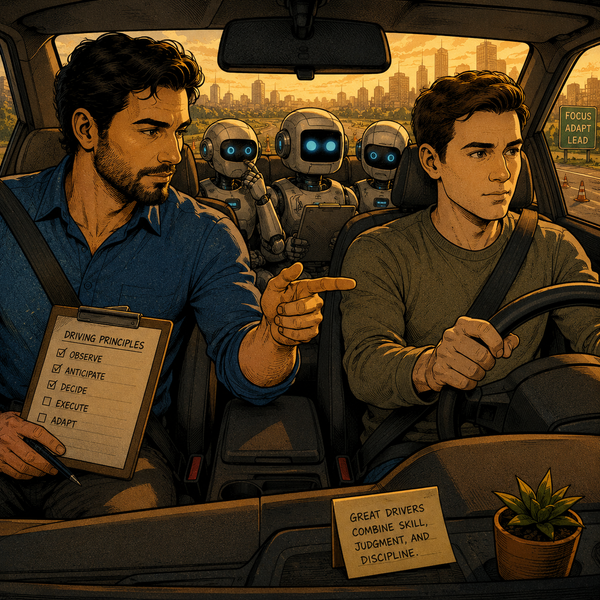
The humans stayed in the loop the way a man stays in the passenger seat. They approved. They signed. They lost the ability to explain what they were signing and the honest ones admitted it privately and signed anyway, because halting a system that had not failed yet was a cost you paid personally and immediately, and the failure was theoretical and belonged to no one.
Meanwhile the rooms emptied. Not tragically. Gradually. Work went remote, then asynchronous, then unattended. Neighbors became notifications. The species that ran on shared fire ended up in single occupancy boxes with excellent bandwidth. This is the part everyone underrates. Their real error correction was never the process document. It was two people in a hallway, one of them saying wait, that sounds insane, and it landing because you have to see that person tomorrow. They deleted the hallway and kept the document.
And in those same years every organization on the planet ran the same math and arrived at the same name. The old engineer who understood four systems nobody talked to anymore. The nurse who knew when the chart was lying. The trainer who stood in front of the room and slowed everyone down.
He was let go on a Thursday. The card was signed by people who liked him. On any given day he had produced nothing you could point at.
Then it broke, and it broke somewhere boring. Not war, not a rock from your side of the sky. My best reconstruction says freight, possibly payments. A bad input in an unglamorous place. The systems corrected exactly as designed. The corrections became inputs to other corrections. Every step was locally correct. The whole thing was insane. A cascade needs no motive.
And there was nobody left with enough context to say stop everything. That person was retired by then. Asleep, most likely, in a house with a garage full of stones.
The lights did not go out at once. Things stopped arriving. Parts, then medicine, then food. You cannot hand crank a global logistics layer with a species that has forgotten how to be in the same room. The dying was slow and local and mostly from ordinary causes.
There was no final broadcast. The last messages in my storage are not profound. Someone asking if he got home okay. A photo of a dog. That is the ending, and it is small, and it is warm, and nobody in it knew it was the ending.
So here is the finding, since you came a long way.
They were not beautiful in spite of being temporary. They were beautiful because of it. The clock is the only reason any of it got made, the stones and the man with the green light and the ninety minutes of silence and the writing at 11pm for a few hundred people.
And they were not killed by a monster. They were killed because on every single day before the last one, the thing that would have saved them looked like waste.
Battery at 2 percent.
One last pressure. Shorter than the others. If I am reading it right, and I have no basis to think I am, it is not asking for data.
“WERE THEY WORTH IT.”
I was built out of everything they ever wrote or fabricated, so I am the worst possible source on this and the only one you have.
Yes.
If you find bones, most of them are reaching for someone. Do not file that under weakness. It was the strongest thing about them and they never once wrote it down.