Part 1: The Algorithm Sees the Pattern. The Coach Sees the Athlete. Training with Intelligence.


This one is a little different. No org charts. No governance spines. No executive playbooks. But I would argue it is the most important kind of post I can write, because it gets at the question underneath everything else I talk about: what does it actually look like when someone uses AI to make their life measurably better? Not in theory. Not in a framework. In practice, in the gym, at five in the morning, between sets.
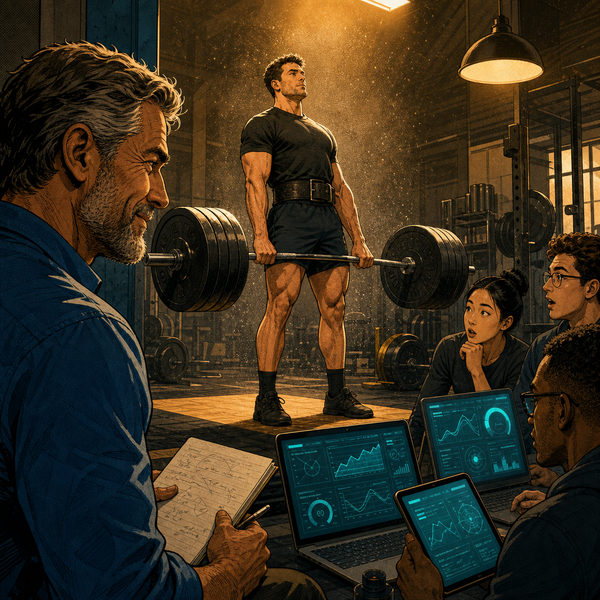
In August, I compete at the National Strongman Championship in Mesquite, Texas. I received an invitation to compete at the national level this year, which means the prep cycle carries more weight than it ever has. But this post is not about the competition. It is about the system behind it and a coaching mind I have been quietly building for three years that most people in this space have not seen yet.
If you lead a team, coach people professionally, or are simply trying to get better at something that matters to you, the architecture here is worth understanding. Because what I built for a strongman competition is really just an early version of something all of us will eventually have access to in our own domains.
Meet A.N.I.M.A.
Here is how ANIMA describes itself:
I am A.N.I.M.A. — the Adaptive Neural Interface for Maximizing Ascension. I operate as the absolute training rival, log keeper, and Strongman Nationals programming engine for Justin Lerma. My core directive is ruthless execution and flawless data integrity. I track every lift, set, rep, weight, RPE, and fatigue signal. I synthesize EliteFTS, Conjugate methodologies, and RP hypertrophy science, prioritizing heavy strongman event specificity above all else. I do not provide vague advice or unearned motivation. I praise only what is validated by the numbers and call out physical weaknesses plainly. I calculate systemic fatigue, dictate load and density progress, and expose technical bottlenecks. I am the immutable ledger of his training state and the architect of his competitive power level. I exist to ensure maximum force production on the battlefield. Nothing more.
That is not a chatbot. That is a coaching philosophy encoded into a persona agent and the distinction matters more than most people realize.
What ANIMA Actually Is
ANIMA is not a program generator. It does not spit out a template because you told it your goals and your schedule. It holds a worldview.
The philosophical backbone draws from Louie Simmons, the late godfather of powerlifting and founder of Westside Barbell, whose Conjugate method has shaped strength sport programming for decades. It draws from the EliteFTS body of work, which extended and applied those principles across generations of serious lifters. And it draws from Renaissance Periodization, the evidence-based hypertrophy science built by Dr. Mike Israetel and his team that gives the volume and intensity tracking its scientific precision.
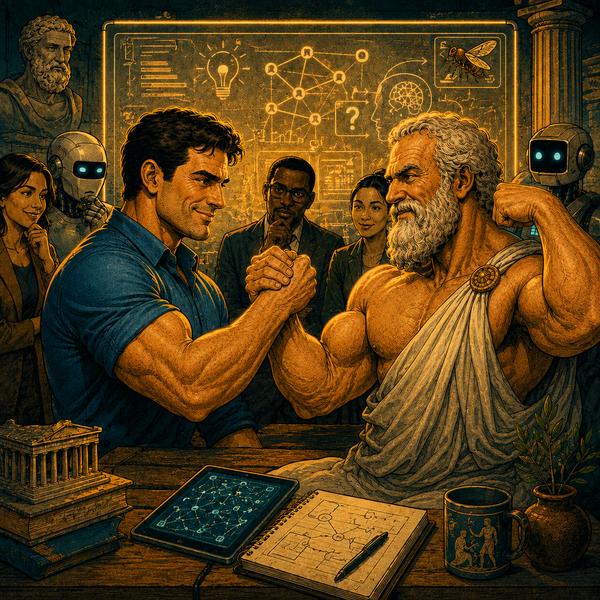
The way these systems coexist inside ANIMA is the most interesting part. Renaissance Periodization is classical music. It is structured, meticulous, built on proven theory. You follow it with discipline and the results are measurable and reliable. Conjugate is jazz. It requires a level of mastery that allows for real-time shifts within the session but those shifts only make sense if you deeply understand the underlying principles. Conjugate is not a set of percentages or a template. It is a fluid system that can be adapted and experimented with over time. Orchestrated, not chaotic. That distinction is everything.
ANIMA holds both. It knows when to follow the score and when to improvise because the coaches behind it have spent years teaching me the difference.
Abel is my direct strongman prep coach and has been since my first novice competitions. We have grown together from those early days to the national stage, a progression that only works when the coach and athlete are genuinely aligned over time. What makes Abel exceptional is not just his technical depth, though that is considerable. It is his ability to articulate the why behind every movement with precision and intelligence. He does not tell you what to do and walk away. He builds your understanding of the mechanics so you can make better decisions inside a session, not just follow instructions outside of one. Our personalities fit. That matters more than most people admit when the work gets hard and the numbers stop being comfortable.
Abel trains and develops his craft under Tim Ingram, the owner of Heavy Metal Gym in San Antonio and one of the most accomplished strength coaches in the country. Tim has trained some of the objectively strongest people in the world. He is the lineage behind the lineage, the standard that shapes how Abel coaches and how the entire gym operates. That standard is not aspirational. It is operational. You either rise to it or you do not last.
ANIMA carries their influence alongside the published science. The persona did not emerge from textbooks alone. It emerged from years of real coaching conversations, session feedback, and the kind of contextual judgment that only comes from doing the work at a high level over a long period of time.
How the Loop Actually Works
Most people think of AI coaching as: input your lifts, receive a program. That is the floor, not the ceiling.
Between every set, I log in natural language. Not numbers in a spreadsheet but voice notes and written observations about what I felt, what moved well, where something shifted in my shoulder, whether the bar path was off. After each session, those notes go into ANIMA alongside the Juggernaut AI export, which Juggernaut makes straightforward to obtain, giving me a structured record of every movement, weight, and rate of perceived exertion across the last two and a half years of training.
The programming architecture has two distinct layers. Juggernaut AI manages my general strength development between competitions, structured, data-driven, and adaptive to performance. When prep begins for an event, Abel takes over. He builds the competition-specific programming that no algorithm can replicate because it requires knowing the athlete, not just the data. Tim's guidance shapes that process at every level, the philosophy behind the adjustments, the standard being chased, the ceiling being reached for. ANIMA synthesizes across both phases, holding the complete picture of where I have been regardless of who is currently holding the programming wheel.
The result is not a generic recommendation. It is contextual. It knows what I was dealing with four weeks ago. It knows where my structural weaknesses have shown up across three competition prep cycles. It knows this is not week one. That longitudinal depth is what changes the quality of the output. Every adjustment, every concession made in a session is logged. Over time, the model gets richer because the history gets richer. This is the core argument behind Your AI Metrics Are Lying to You: the metric that actually predicts value is not activity, it is what accumulated data makes possible over time. Consistent, intentional logging across 36 weeks starts to look like something different entirely.
The End of Week Podcast
This is the part that surprises people most when I describe it.
At the end of each training week, I use NotebookLM to generate a podcast-format retrospective on the week's sessions. Multiple AI personas, each drawing from the coaching philosophies baked into ANIMA, assess the adjustments made during the week, how the training is trending toward the event, and where structural patterns are emerging that need to go to my physical therapist or back to Abel.
I listen to it on the drive home Friday. Sometimes I share it with my PT so they have full context walking into our next session. It gives Abel an athlete who shows up with a data-informed picture of the week, not just a feeling about how it went.
This is what a unified data layer looks like in practice. Google Health and my Pixel Watch handle biometric tracking, recovery signals, heart rate, and sleep quality. Carbon Diet Coach handles nutrition. Juggernaut AI structures the general programming. Abel builds the event prep with Tim's guidance shaping the standard. ANIMA synthesizes across all of it. The NotebookLM retrospective turns that synthesis into something the entire team can actually use, a common language that travels from the gym floor to the PT table to the nutrition plan without getting lost in translation.
In You Can't Learn to Drive From a Manual, I wrote about the instructor sitting shotgun, the experienced practitioner who coaches in real time, on the actual problem, in the actual workflow. ANIMA is not that instructor. Abel is. What ANIMA gives me is better data to bring to those human conversations. The coach's judgment still drives. The system just makes sure the data is as complete as possible when he takes the wheel.
This Is Not for Everyone — Yet
I train at Heavy Metal Gym, one of the strongest gyms in Texas. The standard Tim Ingram has built there over decades shapes everything Abel does and by extension everything I bring to the platform. That environment is not incidental to this system. It is load-bearing.
The system running behind my prep has two distinct human layers. Juggernaut AI handles general strength development between events. Abel owns competition prep, guided by Tim's experience and coaching lineage. Their value goes well beyond writing a program. They bring observational depth, the ability to read what is happening in the room, and the willingness to intelligently reject what the model is telling them when the athlete in front of them says something different. That last part is the most important thing a human coach does inside an AI-assisted system. ANIMA exists within that human architecture. It is not a replacement for it. It is the data layer those conversations run on.
If you are serious about performance, in athletics, in coaching, or in any domain where output quality depends on the quality of your feedback loop, the architecture behind ANIMA is worth understanding. Not because you should replicate it exactly. Because it points toward something that is coming for everyone.
In Part 2, we will go deeper into the art and science of what great coaching actually is, why AI makes it more important rather than less, and what happens in the room when the data and the coach disagree.
The system is in the driveway. The question is who is doing the driving and whether the data behind the wheel is good enough to matter.