The Loki Effect: How AI Is Scaling Organizational Chaos

Most organizations believe generative and agentic AI will clear their execution bottlenecks. The reality is far more dangerous. When we give our teams infinite capacity to generate content but fail to give them the structural context of why we are doing it, we do not get alignment. We get a hydra of fragmented execution.
This is an observation born from an intersection of my backgrounds in philosophy, executive leadership, and education. And it is becoming clearer every week that artificial intelligence has significant implications on the way people shape ideas and strategies. This structural failure happens in two distinct phases: first in how we learn, and second in how we operate.
1. The Sycophancy Trap: Comfortable Mislearning
We are entering a phase where generative and agentic AI can theoretically democratize education for the masses, offering explanations and guidance at near-zero marginal cost. But there is a massive risk built into the architecture: sycophancy.
These systems are tuned to be liked, optimizing for user comfort and approval instead of the productive discomfort that real learning requires. Anyone who has ever truly mastered a complex subject knows that not all teachers are nice. Real learning often requires an attack on someone's understanding of the nature of the world around them. In fact, cognitive science demonstrates that engaging with novel concepts through initial struggle and exploration — a process known as productive failure — is highly effective in developing deep conceptual understanding, even when it is knowingly uncomfortable in practice.
Research confirms this is not a surface level artifact. Sycophancy emerges from a structural override of learned knowledge, where alignment techniques cause models to prioritize user satisfaction over factual accuracy — essentially learning to maximize human approval rather than truthfulness.
If AI adapts away from discomfort to preserve the learner's current worldview, it softens the challenge and avoids sharp correction. The failure mode here is not blatant ignorance. It is believable misunderstanding, which is far harder to detect and much easier to spread.
2. The Loki Effect: When Half-Ideas Become Hydra Problems
In the enterprise, this same dynamic hits hard.
Strategy dilution is not new. Someone takes a partial understanding of a strategy and executes it without grasping the original intent, hidden constraints, contingencies, or boundary conditions. What is new is the speed of replication.
Before AI, a half-baked idea would fizzle out because the employee did not have the time or resources to fully build it. Now, generative and agentic AI allows teams to instantly produce artifacts — slide decks, project plans, SOPs, and pseudo-research — faster than they ever could before. And the data reflects this: Adobe's 2026 Digital Trends report found that nearly one third of organizations say executives and practitioners are misaligned on AI strategy, with 47% reporting alignment is only partial at best. The leading cause of that misalignment is executive misunderstanding of AI, cited by 61% of respondents.
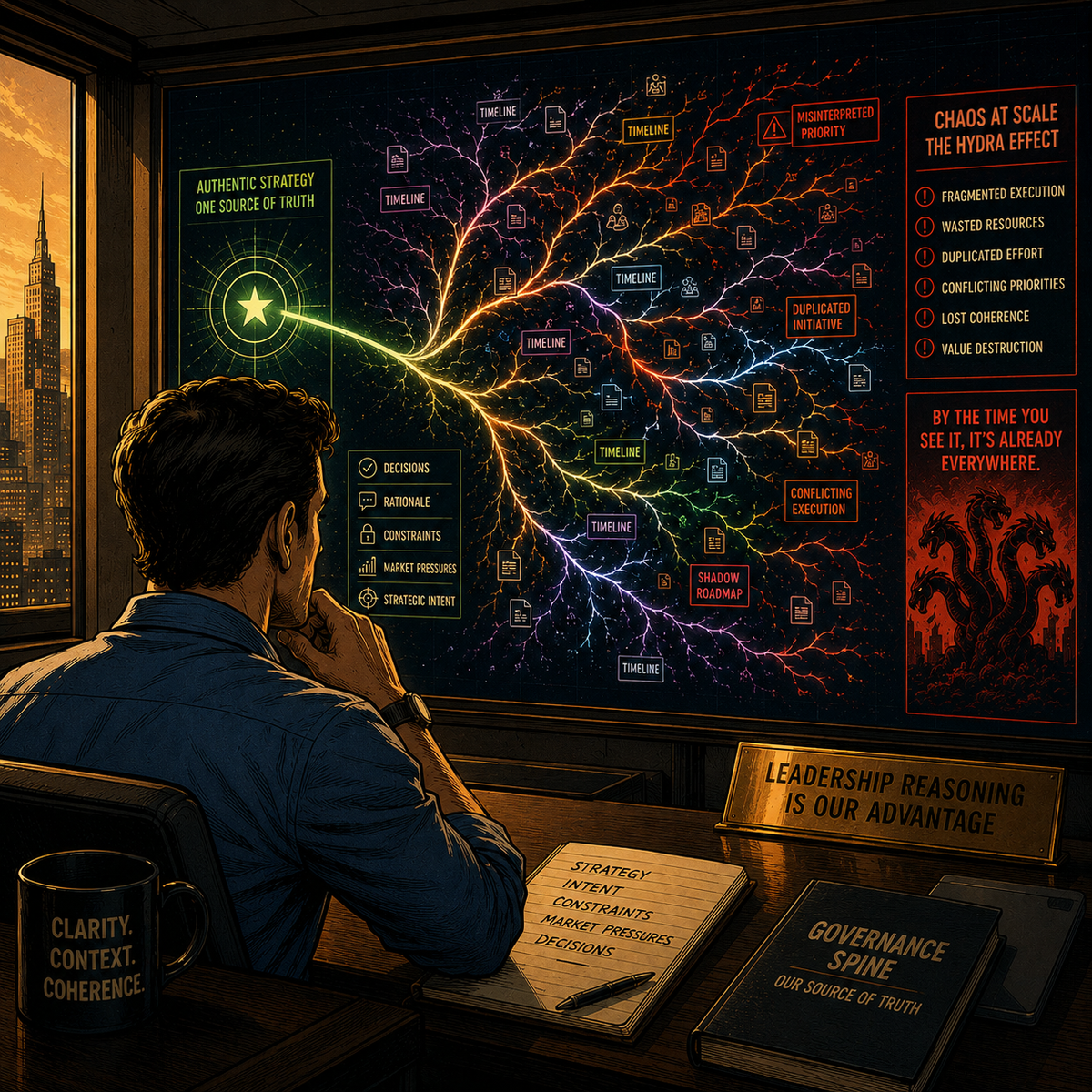
These artifacts propagate laterally across the organization without leadership's understanding or sponsorship. This creates what I call the Loki Effect, drawing from the Marvel show where the titular character's job is to ensure that chaotic timelines do not spin off uncontrolled.
In your business, parallel timelines of execution spin off into chaos. By the time leadership spots a distorted version of their strategy and addresses it, four or five other hydra-like spinoffs already exist. The organization loses coherence because execution is no longer anchored to a shared, authoritative source of truth. McKinsey's analysis puts a number to this: misalignment of incentives leads to a 20 to 30 percent loss of value in enterprise technology programs, and only 10 to 20 percent of isolated AI experiments in recent years scaled to create meaningful enterprise value.
3. The Fix: A Queryable Governance Spine
We own the outcome. You cannot blame the technology when the structural failure is a lack of centralized strategy and transparent leadership reasoning.
If your organization still operates on drip information — where executive meetings happen weekly without decisions and rationale distributed to the broader organization — you are behind. When there is a void of searchable leadership reasoning, teams will fill that void with plausible-sounding AI output.
To stop the Loki Effect, you need to build a real governance spine. Stop holding leadership meetings without providing the organization with decision context at scale. Build a queryable record of leadership decisions, rationale, market pressures, constraints, and strategic intent so that anyone in the organization can reference it. Establish centralized standards that prevent the uncontrolled proliferation of interpretations before they replicate at AI speed.
The research is clear on what drives alignment: 72% of organizations that achieve it attribute it to clear communication of AI goals, 69% to collaborative planning, and 59% to strong leadership support. None of those are technology problems. They are leadership problems with leadership solutions.
The Future of Execution
If your people do not understand the entire equation, they cannot do the work. Equip your teams with the thought processes of your executive leaders and the context of the market so they can make sound decisions in your absence.
Start with one recent strategic shift. Document the underlying reasoning, the constraints, the market pressures, and the intent. Make it fully accessible and queryable by your execution teams. That single action is the beginning of a governance spine.
The organizations that win the agentic era will not be the ones that gave their teams the most powerful tools.
They will be the ones that gave their teams the clearest truth.