The Headless Organization

The Head Is Not Missing
Here's a provocation: the best organizations of the next few years will be headless.
Not leaderless. Headless. There's a difference, and it's the whole point of this piece.
In a headless organization, the head isn't gone. It's off doing other, more important work. It isn't hovering over workflows, jumping into the details of how a specific process runs, or waiting to be pulled into every decision that feels a little too big for the team. The head sets direction, and the system runs on it.
If that sounds like a fantasy, it's because most of us have spent our careers inside organizations built the other way around. Leaders stay close to the work because the work can't move without them. Every escalation, every approval, every "let me loop in my director" is a small admission that the organization's judgment lives in a few people's heads instead of in the system itself.
That model was always expensive. In the agentic era, it becomes untenable.
A Puppy Named Chuy
I learned this lesson somewhere I didn't expect: raising our new puppy, Chuy. That's short for Chewbacca, which fits: he's a black and brown giant schnauzer.
When the family brought him home, we had to make real decisions about how he'd be raised. The biggest one was a principle: no force and no negative reinforcement. Not ever, not by anyone in the house.
That decision could have lived in our heads. Instead, it lives in House Hub, a private web app for our household that I built with a team of AI agents. I set the goals and approved the decisions; the agents designed, built and tested it. Chuy has his own page. His schedule, how much he eats, what he needs, and the decisions we've made about him are all there, visible to everyone in the family. The app also has a feature called Tell: you ask a question in plain language, and an AI model looks up everything we've recorded about him before it answers. Our no force principle is part of that record, so every answer follows it. That's how anyone in the family can check what's safe to feed him without coming to find me first.
Every week, I sit down with Claude and talk it through out loud. What went well, what didn't, what I'm worried about for next week. Because it reads the same notes that power his page in the app, it sees every decision we've already made, so it's a real sounding board, not a blank page. What comes out of that conversation goes back into his page in the app, so the way we raise him keeps getting better.
His potty schedule is the best example. Each week I look at how much he ate, when he ate, and when he needed to go out. Matching those up tells us how long after a meal he needs to be outside, which is the difference between an accident on the floor and a dog waiting at the door. It even tells us when to wake up in the middle of the night to take him out, so we get ahead of the accident instead of cleaning it up.
Here's what I noticed. I'm rarely the one making the call in the moment. The decisions we made together as a family are doing that work. I'm not absent. I'm just upstream.
That's a headless organization, at the scale of one very energetic puppy.
Why Now
We now have agentic orchestration in the hands of ordinary teams. A single person can direct a team of agents. Small groups of humans and agents can collaborate on work that used to take entire departments. The work itself is starting to move at AI speed.
Leadership, for the most part, is not.
Most organizations still cascade vision on a quarterly rhythm. Leaders gather, set direction, and push it down through layers of management over the following weeks. By the time the intent reaches the people doing the work, and now the agents doing the work, it's already aging. At human speed, that lag was tolerable. At AI speed, a quarter is an eternity.
When execution outruns direction, one of two things happens. Either the leader gets dragged back into the weeds to steer manually, or the work keeps moving without clear intent and drifts. I've written before about how AI can scale organizational chaos when nobody is minding the direction. Neither outcome is acceptable, and neither one scales.
The answer isn't for leaders to work harder or stay closer. It's for leaders to change what they produce.
Leadership as Code
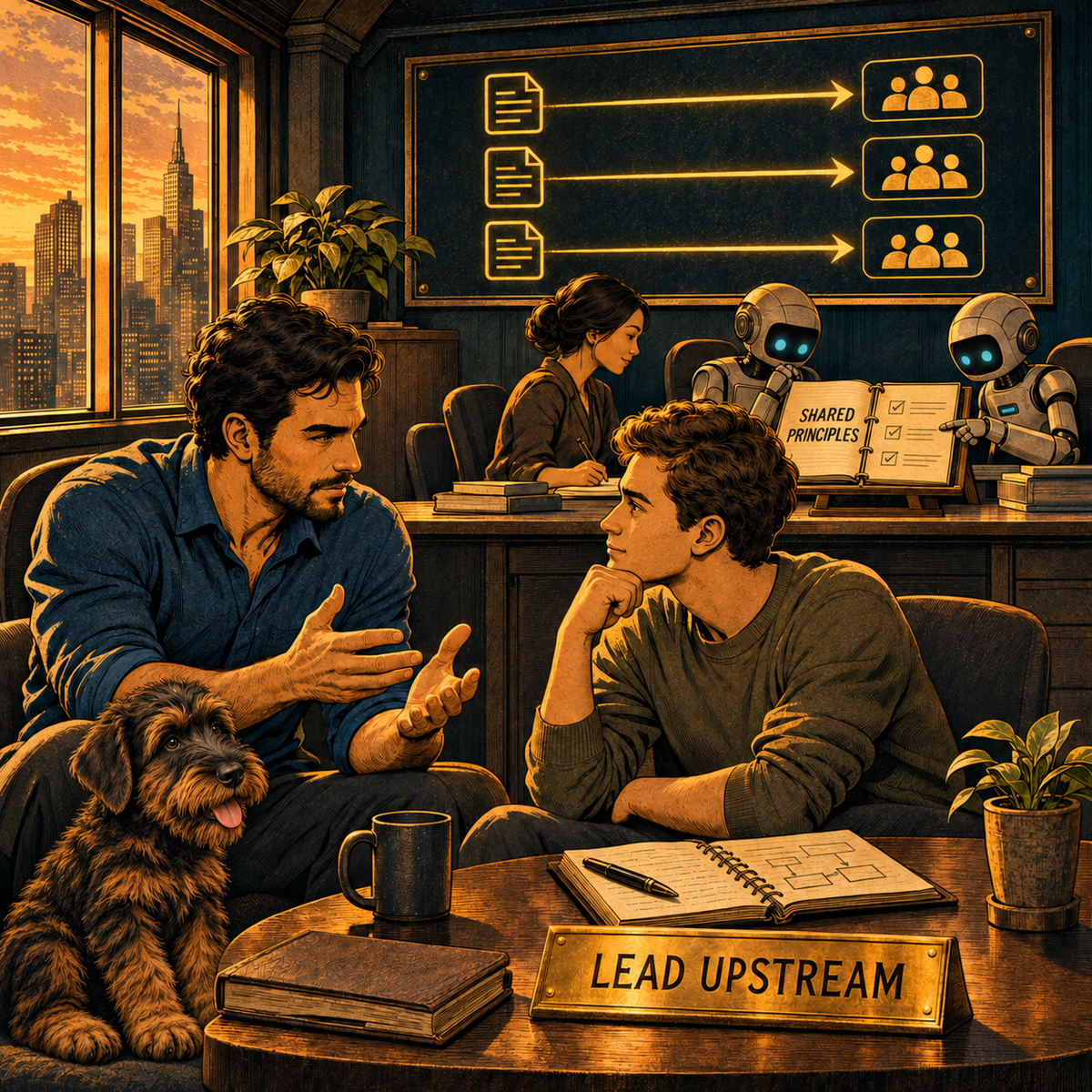
In a headless organization, a leader's primary output is not meetings, approvals, or status reviews. It's decisions and principles, written down in searchable, traceable files that people and agents alike can find and follow.
Think about what that means in practice. When executives have rich conversations with their peers about how they want to steer the company, those conversations don't evaporate when the meeting ends. They get captured. The reasoning, the tradeoffs, the lines they've drawn, and the things they've decided not to do all become part of a living record that the organization can operate from.
That record becomes the lanes. Teams and agents execute within them. When a question comes up, the first place anyone looks isn't a leader's calendar. It's the file.
This also changes the rhythm of leadership. If intent lives in files, it can be refreshed constantly. Vision shouldn't be cascaded quarterly; it should be shared weekly. Leaders should be in regular, deep conversation about how they want to pilot the organization, and the output of those conversations should be exposed to everyone who needs it, as soon as it exists.
This connects directly to what I've described as the operator model for an agentic future. Operators can only move fast and well if they know the boundaries they're operating within. Leadership as code is how you give them those boundaries without standing over their shoulder.
There's a reason this framing borrows from software. Running an organization at AI speed starts to look a lot like running a codebase: versioned decisions, clear ownership, traceable changes, and principles that can be tested. That's a big enough idea that it deserves its own post, and it's coming. For now, the point is simpler. If your organization is going to run on files, the people writing those files are the leaders, and that's a job they need to start doing today.
What Leaders Do With the Time They Get Back
If leaders aren't operating the system, what are they doing? Three things, and none of them are optional.
1. Steer in the open
The first job is writing intent down and keeping it current. Every meaningful decision, every principle, every lane a team is expected to stay inside belongs somewhere searchable. If a decision only exists in a meeting, it doesn't exist for the system.
This is also where rigor matters most. When leaders set principles for something net new, those principles will be followed at scale, by people and by agents, often without anyone stopping to question them. That's exactly why they need to be questioned before they're written. I call this the Gadfly Discipline: what are the assumptions nobody has said out loud yet, what edge case does this break under, and would it survive being defended to someone actively trying to find the hole in it? A flawed principle in a headless organization doesn't fail once. It fails everywhere it's followed.
2. Prune on purpose
The second job is directing investment, and just as importantly, directing divestment.
Agentic tools make it easy to start things. Teams spin up agents, build tools, and launch initiatives faster than any leader can track. Some of that is exactly the experimentation you want. Some of it is sprawl: overlapping efforts, duplicated tools, and teams wandering in directions that don't fit where the organization is headed.
Leaders in a headless organization make pruning a habit, not an annual event. They know what's running, they decide what gets more fuel, and they're intentional about shutting down what no longer fits. Saying "we're not doing this anymore" is one of the most valuable decisions a leader can put in writing.
3. Grow judgment
The third job is the one leaders have always said they wanted more time for: leading, inspiring, and developing people.
When a leader stops operating the system, that time comes back. The best use of it is directly mentoring the people who will make decisions inside the lanes. Judgment doesn't build itself. It's built on purpose, through conversations, coaching, and explaining the why behind the principles, not just the what.
And because it's built on purpose, it can be measured. The clearest signal is simple: how often does your team make the right call using your written principles, without coming to you first? If that number is going up, you're building judgment. If every meaningful decision still lands on your desk, you're the bottleneck, no matter how good your files are.
There's one more habit that ties all three jobs together: a weekly reflection. Every person responsible for anything important should sit down once a week and talk through the decisions they made, what worked, what didn't, and what worries them about the week ahead. We now have agentic sounding boards that can see every past decision and open concern, so that conversation is no longer a journal entry nobody reads. It's how the files stay alive. The same loop that tells us when to get up at 2 a.m. for Chuy, reflect, capture, adjust, is the loop that keeps a team ahead of its problems instead of reacting to them. If it matters for raising a puppy, it matters for running a business unit.
How Headless Are You?
A concept only matters if you can act on it, so I built something you can use today.
Below is a downloadable scorecard covering everything in this post. It walks through the three jobs, steering in the open, pruning on purpose, and growing judgment, and asks you to rate yourself on each item from 1 to 5. Each section is scored on its own, so you can see exactly where you're strongest and where you're still operating the system instead of leading it.
Take it now. Then take it again in a month. The direction of your score matters more than the number.
Get your own copy of the How Headless Are You? scorecard
The Head Has Somewhere Better to Be
The headless organization isn't about leaders disappearing. It's about leaders moving upstream, out of the workflows and into the decisions, principles, and people that make those workflows run well without them.
The organizations that figure this out will move at the speed their tools allow. The ones that don't will keep dragging their leaders back into the weeds, wondering why everything still feels slow.
And if your organization is going to run on files, it's going to need the discipline that engineers have spent decades refining for managing exactly that. That's the next post.