The Executive Playbook for AI Structural Change — Q1 2026

AI transformation is not a tooling initiative.
It is a people, process, and performance initiative disguised as technology.
If it does not change how your organization learns, operates, and simplifies itself, it is decoration.
Most executives are asking what they should start doing in the age of AI.
The more important question is what they must stop tolerating.
1. Stop Treating AI Like a Side Project
If AI capability is not embedded into hiring criteria, promotion standards, performance reviews, and training velocity, it is ornamental.
Within six months, every executive should be able to articulate the current AI literacy baseline, the future-fit capability required to remain competitive, and the structured pathway to close that gap.
Skill development is no longer optional. It is a retention strategy.
If your training velocity lags behind innovation velocity, your best talent will leave to learn elsewhere.
2. Stop Confusing Tool Access With Capability
Licenses do not equal leverage.
You must make a deliberate architectural choice. Do you optimize around one omni-tool that serves most roles adequately? Or do you build a segmented ecosystem of specialized agents, personas, and workflow automations?
Either approach demands a cohesive data backbone.
Fragmented experimentation without shared infrastructure creates noise. Centralized control without experimentation creates stagnation.
You need both authority and optionality.
3. Stop Ignoring Cultural Telemetry
AI adoption is psychological before it is technical.
If you are not measuring workforce sentiment, comfort levels, and perceived support, you are operating blind.
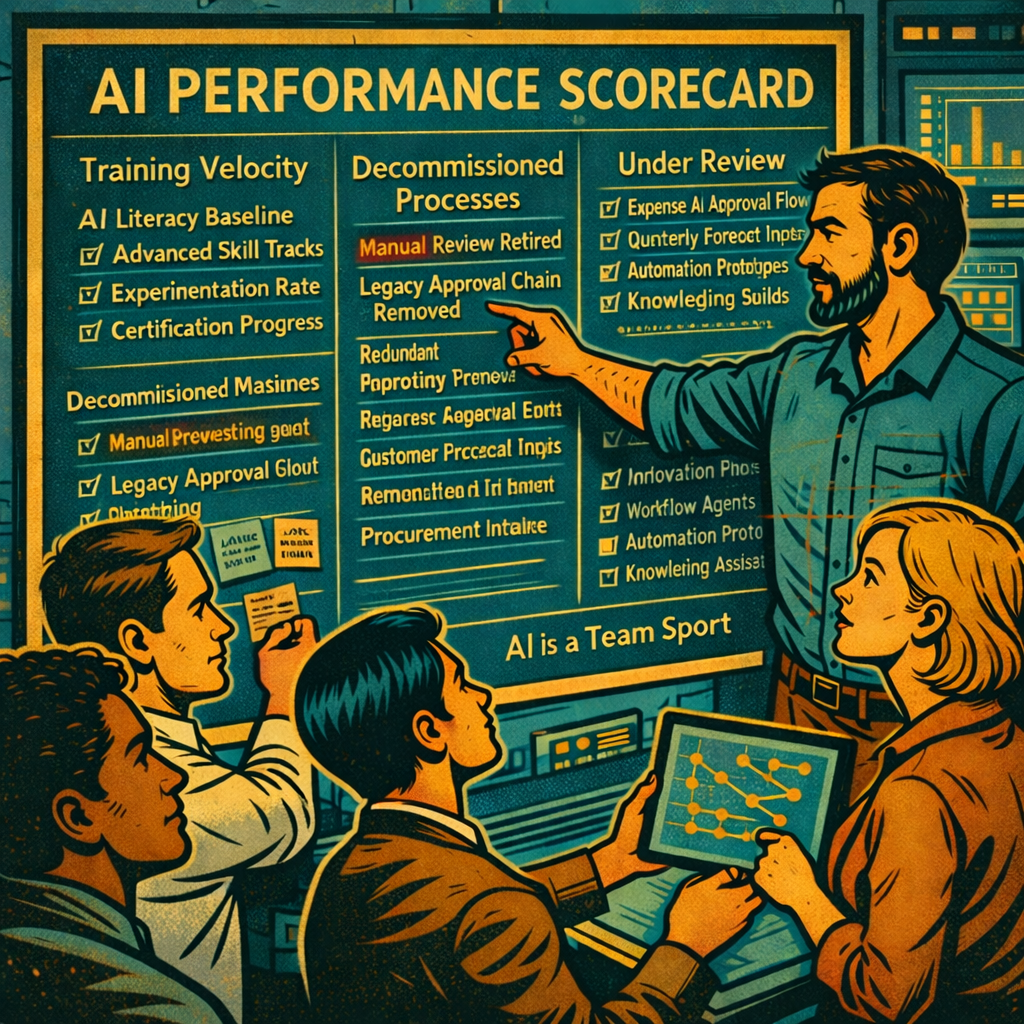
AI readiness should have a visible scorecard: adoption rates, comfort with AI-assisted outputs, experimentation frequency, and perceived leadership support.
If culture is not measured, it is unmanaged.
Accountability must extend beyond financial performance into capability performance.
4. Stop Centralizing Innovation to Death
You need two parallel systems.
Authoritative AI systems that standardize process, protect customers, and maintain quality.
And open experimentation lanes where teams can build agents, redesign workflows, and prototype new operating models.
Those innovations must be discoverable. They must be evaluated. They must be rewarded.
If internal builders are not recognized, they will stop building. Or they will build somewhere else.
5. Stop Measuring Activity Instead of Structural Change
If AI transformation is real, bureaucracy should shrink.
Every executive should maintain a living ledger of processes decommissioned, manual reviews retired, approval chains collapsed, and legacy reporting eliminated.
If nothing is being retired, nothing is transforming.
Parallel to that ledger should be a second list of processes under review, bottlenecks crowdsourced from frontline employees, and friction points identified by the people doing the work.
Your workforce is your best operational dataset.
Capture it. Review it. Act on it.
These items should be evaluated by a standing review board composed of operators who understand why the process originally existed, AI-literate leaders who understand what is now possible, and builders who can prototype alternatives quickly.
Past reasoning matters. But constraints change.
Every quarter, executives should be able to answer three questions:
- What did we eliminate?
- What are we actively redesigning?
- What did we consciously decide to keep — and why?
Transformation without subtraction is theater.
If your organization is not measurably lighter and faster within a year, you are digitizing complexity rather than removing it.
6. Stop Leading With Fear
“Keep your job” is not a strategy.
You can push people forward with anxiety. Or you can pull them forward with opportunity.
AI advancement should connect to recognition, visibility, compensation pathways, and career acceleration.
If your AI transition is built on implied redundancy, you are not leading.
You are managing decline.
Artificial intelligence will not replace leaders.
But it will expose the ones who aren't transforming the way they think, decide and act. We can see it. We have the technology.
If your organization is not lighter, faster, and more capable within a year, you are not transforming.
You are digitizing inertia.